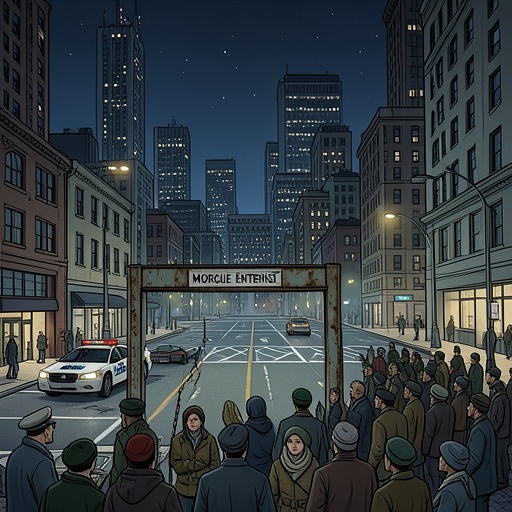
The city is the offense. We are the defense.
Night Train“The city is the offense. We are the defense.” is the guiding formulation for the police role in Mike Hoolihan’s account: the city supplies the offenses, and the police define themselves as the force set against them. The sentence turns a sprawling institution into a compact statement of purpose, while its blunt symmetry leaves little room between the two sides it names.
Institutional Setting
The expression appears as Mike describes the Criminal Investigation Division downtown, an organization of three thousand sworn personnel divided among departments, sections, and units. The list ranges from Organized Crime and Major Crimes to Sex Offenses, Auto Theft, Narcotics, and Homicide; its names, she notes, are always changing. Against that bureaucratic abundance, the phrase offers a simple organizing principle: many kinds of offenses, one defensive function.
The distinction between crime and sin sharpens that institutional perspective. Mike observes, “There is a glass door marked Vice. There is no glass door marked Sin.” The department has a place for a legally defined category, not for the broader moral abstraction. The slogan that follows likewise frames policing as a response to offenses rather than as a general judgment on the city’s people or character.
Meaning and Narrative Function
The sentence’s opposition is forceful but deliberately general. “The city” stands for the field of offenses the institution confronts; “we” gathers its police personnel into a collective defense. The phrasing presents police work as the counterforce to urban wrongdoing, compressing the division’s many changing units into a single civic rationale.
That rationale belongs to Mike’s professional self-understanding. She identifies herself as a policewoman in the department’s own idiom and recounts a career that took her from foot patrol and robbery work into plainclothes assignments, Homicide, and then Asset Forfeiture. In this setting, the expression is more than a slogan about a city: it is the broad premise behind the work of a detective who has spent years handling its offenses.